






Introducing Exowatt: Powering the AI Era with 24-Hour Clean Energy
In a world where data centers, artificial intelligence (AI) workloads, and high-performance computing are surging, the demand for reliable, affordable, and carbon-free energy has never been higher. That’s where Exowatt comes in: a startup reinventing the way we collect, store, and dispatch solar energy — delivering power on demand, not just when the sun shines.
Company Snapshot
-
Founded in 2023 in Miami, Florida, by Hannan Happi (CEO) and Jack Abraham, via venture-studio Atomic. (Wikipedia)
-
Privately held, backed by heavy-hitter investors including Andreessen Horowitz (“a16z”), Sam Altman, and Felicis Ventures. (Exowatt)
-
Raised $70 million in a Series A round (bringing total funding to ~$90 M) in April 2025, with a strong U.S. manufacturing commitment. (Exowatt)
-
Headquarters: Miami, Florida, USA. (World Economic Forum)
The Technology: How Exowatt Works
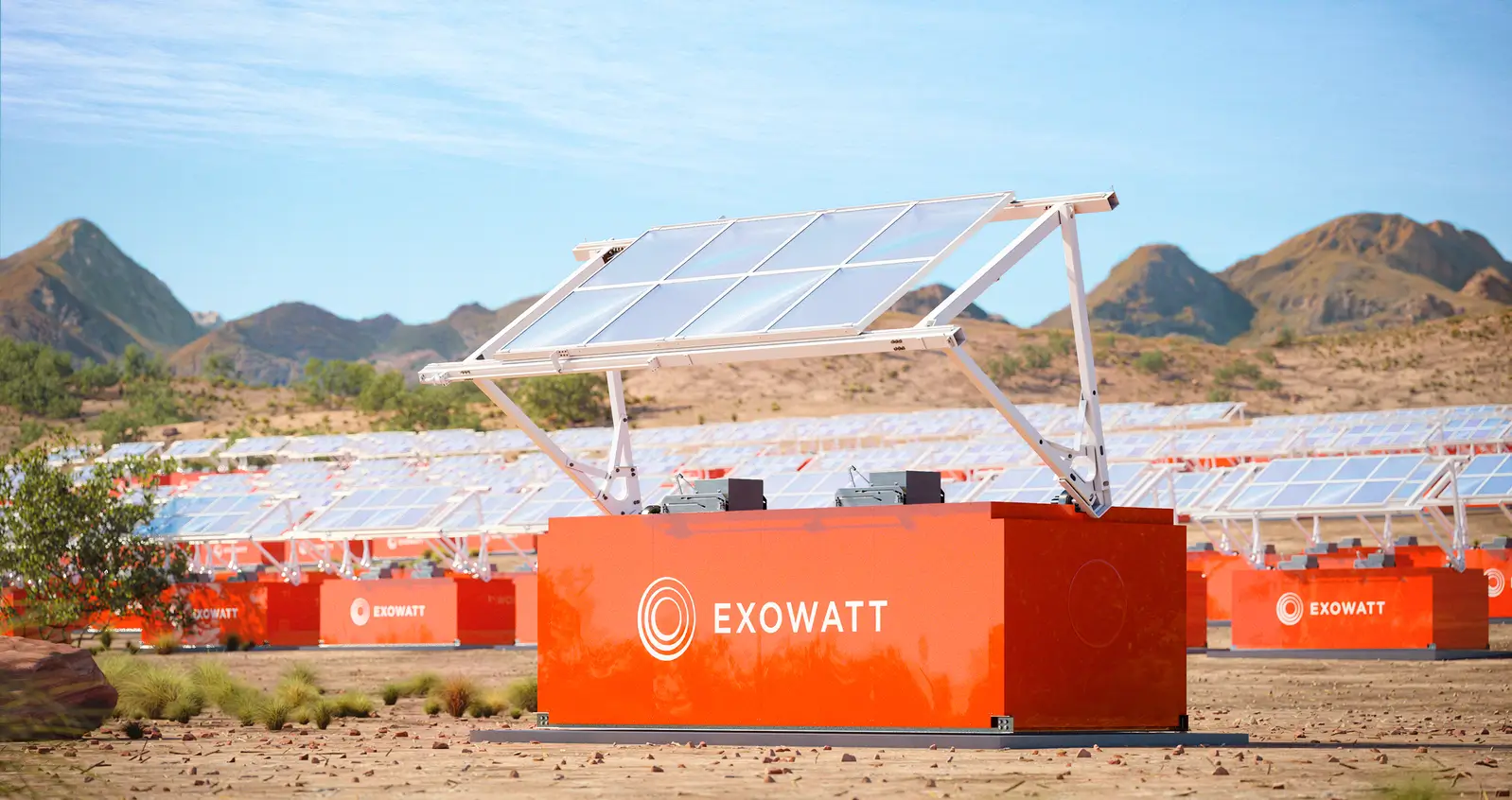
The heart of Exowatt’s innovation is its flagship product: the P3 module — a factory-built, shipping-container-sized energy system that captures solar energy, stores it as heat, and then converts it into electricity on demand, achieving true dispatchability. (Exowatt)
Here’s a breakdown of its three core stages:
-
Capture – Using proprietary Fresnel-lens solar concentrators, the P3 system focuses sunlight into a high-temperature heat exchanger. (Data Center Frontier)
-
Store – The heat is stored in a durable, high-temperature thermal battery (a “blanket” of heat-holding material) that retains energy much longer than typical batteries. (Facilities Dive)
-
Dispatch – When electricity is needed (day or night), a proprietary heat engine converts the stored thermal energy into electric power, giving 24-hour availability. (Exowatt)
Key differentiators:
-
Up to 24 hours of dispatchable power (even when the sun isn’t shining) — solving one of solar’s biggest challenges. (Exowatt)
-
U.S.-manufactured, with minimal reliance on rare-earth minerals or complex supply chains. (Utility Dive)
-
Initial cost estimates around $0.04 per kWh, targeting as low as $0.01 per kWh with scale. (Facilities Dive)
Market Focus & Why It Matters
With the rise of large AI models and the explosive growth of data centers, the energy demands are skyrocketing. Exowatt positions itself to meet that demand by offering:
-
On-site, scalable energy modules for data centers, hyperscalers, commercial and industrial (C&I) facilities. (Exowatt)
-
A way to “bring your own power” (BYOP) and bypass grid-interconnection delays. (Data Center Frontier)
-
Baseline renewable energy (not just peak usage) — meaning cleaner, reliable power for 24/7 operations.
In other words, Exowatt aims to shift renewables from “when the sun shines” to “whenever power is needed” — enabling new possibilities for AI, edge computing, manufacturing, and more.
Challenges & Considerations
No disruptive technology is without its hurdles. Some of the key issues and critiques:
-
Scalability: Deploying at utility scale and proving long-term durability in diverse environments remains a challenge. (Latitude Media)
-
Capital-intensity: Thermal storage systems and concentrators may require larger footprints or more upfront cost than traditional solar + battery systems.
-
Adoption timeline: Commercial implementation is still ramping; real-world deployments are needed to validate claims of cost and longevity.
Why It’s Exciting
-
Exowatt’s modular design allows for faster deployment, particularly valuable for time-sensitive infrastructure like data centers.
-
Its focus on U.S. manufacturing and minimal reliance on rare earths aligns with current geopolitical and supply-chain trends.
-
If Exowatt can deliver on its cost targets, it could significantly disrupt energy economics for high-power customers.
What’s Next
-
The firm aims for commercial deployments starting in 2025 across multiple U.S. sites. (Exowatt)
-
Investors are watching closely as Exowatt moves from prototype to production.
-
As AI, edge computing and datacenter build-outs accelerate, solutions like Exowatt’s may become highly strategic for companies seeking clean, firm, on-site power.
Bottom Line:
Exowatt isn’t just another solar startup — it’s tackling one of the most persistent problems in renewable energy: how to make clean power reliable, scalable, and cost-effective at all hours. If successful, Exowatt could redefine how data centers and energy-intensive operations think about their energy supply.